Agentic Marketing: How to Escape Gimmicky AI and Build Real Strategy
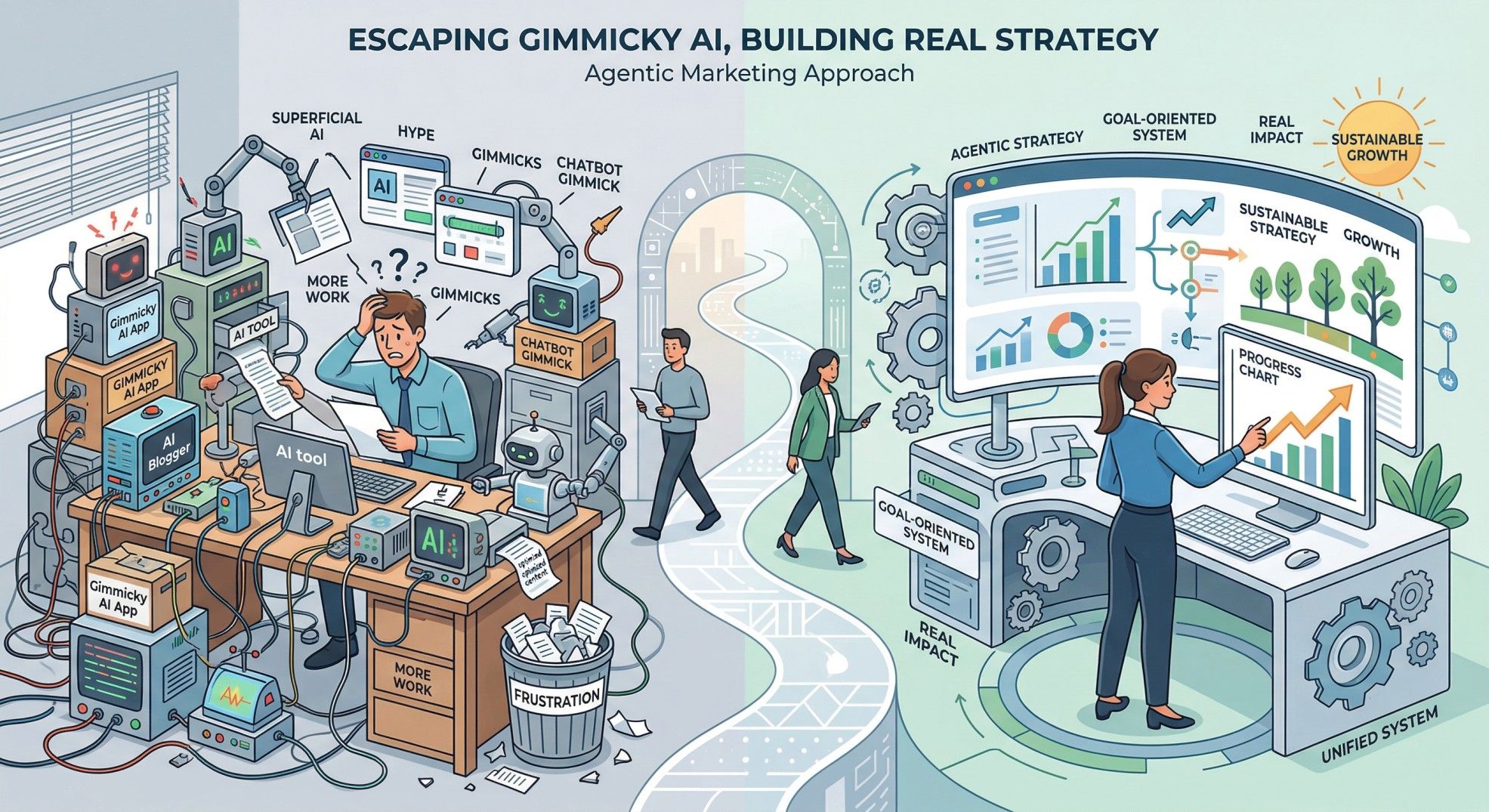
AI is everywhere in marketing right now. Every other tool promises to revolutionize your strategy, from content creation to customer engagement. But are we really seeing revolutionary results, or just a lot of hype?
You're probably feeling the pressure to adopt AI. Yet, many of us are finding these "AI tools" deliver superficial results. They often create more work than they solve, right?
This is where Agentic Marketing comes in. It's a powerful shift from simply using AI tools. Instead, we're talking about a strategic, goal-oriented approach to AI.
My goal today is to show you how to leverage AI for real impact. We'll move beyond those fleeting gimmicks. It's time to build a truly sustainable marketing strategy.
But first, let's get clear on what we're trying to escape. What exactly do these "gimmicky AI" approaches look like?

Introduction
The buzz around AI in marketing is undeniable. Every other tool promises to revolutionize your strategy, from content creation to customer engagement. It feels like AI is everywhere, and the pressure to adopt it is real.
But for many of us, the reality hasn't quite matched the hype. We're often left feeling overwhelmed by a flood of "AI tools" that deliver superficial results. They can even create more work than they solve, right?
This is where I want to introduce you to Agentic Marketing. It represents a powerful shift from simply using AI tools. Instead, we're talking about a strategic, goal-oriented approach to leveraging artificial intelligence.
My promise today is to show you how to harness AI for genuine impact. We'll move beyond those fleeting gimmicks and build a truly sustainable marketing strategy.
To truly understand this shift, we first need to identify the pitfalls. What exactly do these "gimmicky AI" approaches look like, and why do they fail us?

The Pitfalls of Gimmicky AI in Marketing
You asked what these "gimmicky AI" approaches look like, and why they often fail us. Let's pull back the curtain on the kind of AI use that promises much but delivers little. We've all seen it, and perhaps even fallen for it.
What "Gimmicky AI" Looks Like
At its core, gimmicky AI is about superficial application. It's often a quick fix, not a strategic solution.
Think about one-off content generation. You might use an AI tool to churn out a blog post or a social media caption. But does it truly capture your brand's unique voice or context?
Often, these are automated tasks lacking real strategic oversight. They perform an action, but without understanding the bigger picture or integrating with your broader marketing goals.
The focus is on novelty over utility. We get excited by an "AI-generated image" or a "chatbot" simply because it's AI. We forget to ask if it actually serves a business purpose.
Crucially, these systems often lack continuous learning or adaptation. They don't get smarter over time or adjust based on real-world performance.
Why It Fails to Deliver Real Value
So, why do these flashy, yet shallow, AI applications fall short? The reasons are clear, and they hit your bottom line.
Firstly, they produce generic, uninspired, or even off-brand outputs. Without context or understanding, AI can't create truly compelling content that resonates.
These tools simply don't understand user intent, market nuances, or your specific business goals. They operate in a vacuum, unable to grasp the complexities of human behavior or competitive landscapes.
This leads to wasted resources. You invest time and money into tools that create more work for your human teams, who then have to edit, refine, or completely redo the AI's output.
Worst of all, relying on gimmicky AI can damage your brand reputation and customer trust. Generic, irrelevant, or even inaccurate AI-generated content can alienate your audience.
It's clear that simply "using AI" isn't enough. We need a more thoughtful, integrated approach. If these are the pitfalls, what's the path forward? That's where Agentic Marketing truly shines.
Understanding Agentic Marketing
If the pitfalls of gimmicky AI are clear, what's the path forward? That's where Agentic Marketing truly shines. It’s not just a buzzword; it’s a fundamental shift in how we approach artificial intelligence in our strategies.
At its core, Agentic Marketing refers to AI systems. These systems are designed to act autonomously. They work towards specific, high-level marketing goals, learning and adapting over time.
Think of it as moving beyond simple automation. We're talking about AI that thinks, plans, and executes with purpose.
Key Characteristics of Agentic Systems
What makes an AI system truly "agentic"? It possesses several distinct qualities that elevate it beyond a basic tool.
Firstly, it is Goal-Oriented. These systems are driven by clear, measurable business objectives. We're talking about increasing conversion rates by X% or improving customer retention.
Secondly, agentic AI is Autonomous & Proactive. It doesn't wait for constant human prompting. Instead, it initiates actions and makes decisions independently to achieve its goals.
It's also deeply Context-Aware. This means understanding your brand guidelines, audience segments, market trends, and historical data. It operates with a full picture, not in a vacuum.
Crucially, agentic systems are Learning & Adaptive. They continuously improve performance. This happens through real-time data analysis and feedback loops, getting smarter with every interaction.
Finally, they are Integrated. An agentic system works seamlessly within your broader marketing technology stack. It connects, shares data, and collaborates with other tools.
Agentic vs. Traditional/Gimmicky AI
This is where the real distinction lies. Gimmicky AI is often a one-off task performer. It's a hammer for a single nail.
Agentic Marketing, however, views AI as a strategic partner. It's not just doing a task; it's working towards an objective. It learns, adapts, and contributes to your overarching strategy.
We're shifting from AI as a simple "tool" to AI as an intelligent, evolving collaborator. It's about empowering AI to drive outcomes, not just outputs.
To truly leverage this power, we need to understand the foundational elements. What are the core principles that underpin an effective Agentic Marketing strategy? Let's dive into those next.
Core Principles of an Agentic Marketing Strategy
The previous section highlighted how Agentic Marketing is a strategic partner, not just a tool. To truly harness this power, we need a solid foundation. It's about setting the stage for AI to thrive. Let's dive into the core principles that underpin an effective Agentic Marketing strategy.
Define Clear, Measurable Objectives
This is where it all begins. Before you even think about AI, you need to know your destination. What specific outcomes are you trying to achieve? We're talking about tangible, quantifiable goals.
Without clear objectives, your agentic systems will wander aimlessly. They need a target to aim for. This ensures every AI action contributes to your business success.
Data-Driven Foundation
Think of data as the fuel for your agentic engine. High-quality, integrated data is absolutely critical. Your AI systems learn, adapt, and make decisions based on this information.
"Garbage in, garbage out," as the saying goes. We need clean, comprehensive data to power truly intelligent actions. This foundation ensures reliable and effective AI performance.
Iterative Development & Optimization
Agentic Marketing isn't a one-and-done setup. It's a journey of continuous improvement. We recommend starting small, testing your hypotheses, and learning from the results.
Then, you expand capabilities based on what works. This iterative approach ensures constant optimization and adaptation to market changes.
Human-in-the-Loop Oversight
This is a crucial principle. Agentic AI augments human strategy and creativity; it doesn't replace it. Your human teams provide the strategic direction, ethical guardrails, and creative spark.
AI handles the heavy lifting and optimization, but we remain in control. It's a powerful partnership where human insight guides AI execution.
Ethical Considerations
Finally, we must always operate responsibly. This means prioritizing transparency in how AI works. We need to actively mitigate bias in our data and algorithms.
Data privacy is paramount, ensuring we respect user information. Responsible AI use builds trust and protects your brand, fostering long-term success.
These principles form the bedrock of a successful agentic strategy. With these foundations in place, we can start to build. So, how do we translate these principles into action? Let's look at the practical steps for building your own Agentic Marketing framework.
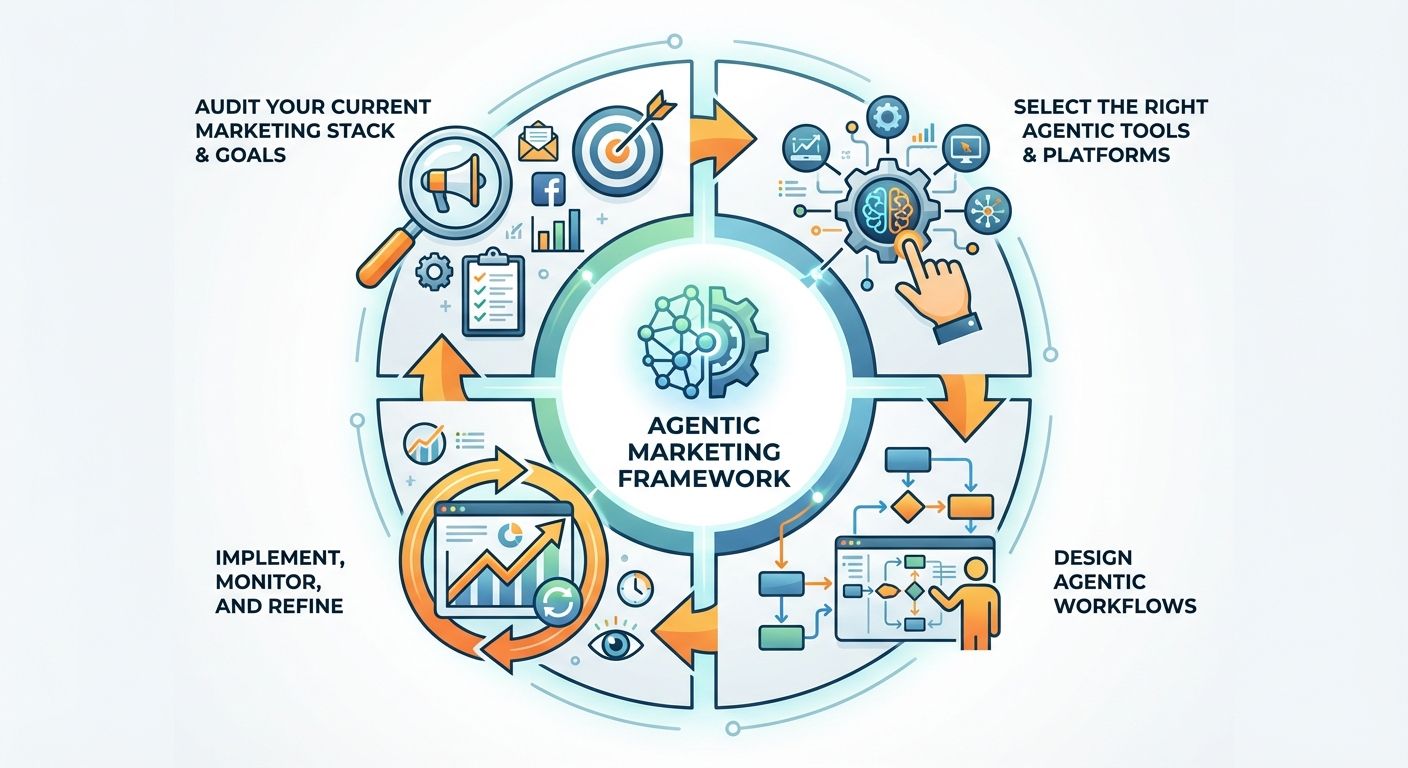
Building Your Agentic Marketing Framework (Practical Steps)
We've just explored the core principles that make Agentic Marketing so powerful. Now, let's translate those foundational ideas into concrete action. It's time to build your own Agentic Marketing framework, step by practical step.
This isn't about chasing the next shiny AI tool. It's about strategically integrating intelligent systems to drive real, measurable outcomes for your business.
Step 1: Audit Your Current Marketing Stack & Goals
Before you implement anything new, we need to understand your starting point. Take a close look at your existing marketing tools and processes.
Identify current pain points, inefficiencies, and areas where your team spends too much manual effort. More importantly, pinpoint strategic opportunities.
Where can AI provide agentic value, not just basic automation? We're looking for places where AI can act autonomously towards a goal, not just complete a single task.
Step 2: Select the Right Agentic Tools & Platforms
Once your audit is complete, you'll have a clearer picture of your needs. Now, it's time to choose the right technology partners.
Look for solutions that offer robust integration capabilities with your existing stack. Prioritize platforms with strong learning capabilities and goal-setting features.
These tools should align directly with your specific objectives. Think advanced personalization, predictive analytics, or dynamic content optimization, not just generic content generation.
Step 3: Design Agentic Workflows
This is where you map out how your AI agents will operate within your ecosystem. How will they interact with your data, other tools, and your human teams?
Consider the flow of information and decision-making. For example, imagine an AI agent monitoring customer sentiment across channels.
It could identify emerging trends, proactively suggest content topics to your creative team, or even recommend specific support interventions. This is about intelligent orchestration.
Step 4: Implement, Monitor, and Refine
Agentic Marketing is an iterative journey, not a destination. We recommend starting with pilot projects to validate your hypotheses and gather initial data.
Establish clear Key Performance Indicators (KPIs) to measure your agent's performance. How well is it achieving its defined objectives?
Continuously feed back data and insights to improve agent effectiveness. This ongoing refinement ensures your systems are always learning and adapting, getting smarter over time.
By following these practical steps, you're not just adopting AI; you're strategically integrating it into the fabric of your marketing operations. With this framework in place, you'll be ready to unlock the incredible real-world applications of agentic marketing that we'll explore next.
Real-World Applications of Agentic Marketing
We've just laid out the practical steps for building your Agentic Marketing framework. Now, let's bring it to life. With that strategic foundation in place, you're ready to unlock the incredible real-world applications of agentic marketing.
This is where the rubber meets the road, transforming principles into tangible results across your marketing efforts.
Personalized Customer Journeys
Imagine a system that truly understands each customer. Agentic AI can dynamically deliver content, product recommendations, and tailored messaging. It adapts in real-time across every channel.
This goes far beyond basic segmentation. We're talking about a continuously evolving journey, unique to each individual.
Predictive Analytics & Lead Scoring
Agentic systems excel at sifting through vast amounts of data. They identify high-value prospects and anticipate customer churn.
This allows you to optimize sales outreach with precision. You'll know who to talk to, when, and with what message.
Dynamic Ad Optimization
Forget static ad campaigns. Agentic marketing enables real-time bidding adjustments and continuous creative testing.
It intelligently segments audiences and allocates budgets for maximum impact. Your ads become smarter and more effective with every impression.
Content Strategy & Creation
Agentic AI can become a strategic partner in your content efforts. It identifies content gaps and generates detailed outlines.
It optimizes for SEO and engagement, even personalizing content at scale. This frees your human teams for higher-level creative work.
Customer Service & Support
Think beyond basic chatbots. Agentic systems can offer proactive issue resolution. They provide intelligent, adaptive support that learns from every interaction.
This leads to personalized self-service options that truly empower your customers. It builds loyalty and reduces strain on your support teams.
These applications demonstrate the power of moving beyond gimmicky AI. They show how agentic systems can become strategic partners, driving real business outcomes. However, embracing this future isn't without its considerations. Next, we'll explore how to overcome challenges and ensure your agentic marketing success.
Overcoming Challenges and Ensuring Success
We've just seen the incredible potential of agentic marketing in action, from hyper-personalized customer journeys to dynamic ad optimization. These applications truly transform how we approach marketing. However, embracing this powerful future isn't without its considerations. As we integrate these sophisticated systems, we'll inevitably encounter hurdles. Let's explore how to overcome these challenges and ensure your agentic marketing success.
Data Quality & Integration
Agentic systems are only as good as the data they consume. The "garbage-in, garbage-out" principle is more critical than ever here. Poor data quality or fragmented sources can severely limit AI's effectiveness.
We need to prioritize clean, accurate, and unified data. This means investing in robust data governance and integration strategies across your entire tech stack. A 2024 study by Salesforce found that 80% of business buyers expect personalized experiences, but only 36% of companies feel they have the right technology to deliver it—often a data integration issue.
Skill Gap & Training
It's not just about the technology; it's about the people who wield it. Your marketing team needs to evolve from simply using tools to becoming strategic partners with AI. This requires new skills.
We must invest in training to bridge the skill gap. Teams need to understand how to define objectives, interpret AI outputs, and provide effective oversight. According to a recent Gartner report, by 2026, 70% of organizations will have adopted AI for marketing, but only 20% will have achieved significant business value due to lack of strategic integration and talent.
Trust & Transparency
For agentic systems to truly succeed, your human teams must trust their decisions and outputs. This trust is built on transparency. We need to understand why the AI made a particular recommendation or took a specific action.
Building confidence means designing systems that offer explainability. This allows for human oversight and intervention when necessary, fostering a collaborative environment.
Scalability
As your business grows and your marketing needs evolve, your agentic systems must be able to scale with you. Don't build a solution that can't adapt to increased data volumes, new channels, or expanding objectives.
We need to design for flexibility and robustness from the outset. This ensures your AI investments remain valuable and effective long-term.
Ethical Governance
Finally, responsible AI use isn't just a buzzword; it's a necessity. We must establish clear ethical guidelines and oversight mechanisms for our agentic systems. This includes addressing potential biases, ensuring data privacy, and maintaining fairness in all AI-driven interactions.
Prioritizing ethical governance builds customer trust and protects your brand reputation. It's about ensuring AI serves your business and your customers responsibly.
Addressing these challenges head-on isn't just about avoiding pitfalls; it's about building a resilient, effective, and ethical marketing future. By proactively tackling these areas, you'll pave the way for true agentic success. This strategic approach ensures your AI investments deliver lasting value, setting the stage for what's next in the evolution of marketing.
The Future of Marketing is Agentic
We've journeyed through the landscape of agentic marketing, from understanding its core principles to building practical frameworks and overcoming critical challenges. It's clear that moving beyond gimmicky AI isn't just an option; it's the strategic imperative for unlocking true, lasting value. Agentic marketing represents a profound shift in how we approach our craft.
It's about transforming our relationship with technology. Instead of merely using tools, we're cultivating intelligent systems that act autonomously towards our highest-level goals. This strategic path is how we truly unlock AI's immense potential.
So, where do you begin this transformative journey? My advice is to start small, but think big. Identify a specific pain point or a clear objective where an agentic approach can make a measurable difference.
Embrace the learning curve, experiment, and iterate. The path to agentic success is built on continuous adaptation and refinement. Your insights and oversight remain crucial.
The future of marketing isn't just about using more AI tools. It's about cultivating intelligent, proactive partners that work tirelessly towards your strategic goals. These systems will augment our creativity, amplify our impact, and redefine what's possible.
Agentic marketing isn't just a trend; it's the indispensable foundation for the next era of strategic growth. It's time to move from reactive tools to truly indispensable marketing partners.